
Native American Accessory
Showing 55–95 of 95 results
-

Native American feather earring
-

Native American Flute – Bamboo Indian Clarinet
-

Native American flute – Indian pan flute
-

Native American flute – quena flute
-

Native American geometric rug
Price range: £25.99 through £50.99 🛒 This product has multiple variants. The options may be chosen on the product page -

Native American Moonstone Ring
-

Native American Navajo rug
Price range: £21.99 through £46.99 🛒 This product has multiple variants. The options may be chosen on the product page -

Native American peacock Indian headdress
-

Native American Ring – Indian Style
-

Native American Ring – Spirit of America
-

Native American Ring Indian Chief Head
-

Native American ring Indian headdress ring
-

Native American ring Indian Navajo ring
-

Native American rug
Price range: £21.99 through £46.99 🛒 This product has multiple variants. The options may be chosen on the product page -

Native American seed bead bracelet
-

Native American Tattoo – Indian and the Wolf
-

Native American Tattoo – Indian Wolf
-

Native American Tattoo – Native American Arrows
-

Native American Tattoo – Native American Eagle
-

Native American Tattoo – Native American feather dart
-

Native American tattoo – Native American woman
-

Native American tattoo – Native American woman color
-

Native American Tattoo – The Native American Sachem
-

Native American tattoo the Native American cat
-

Native American Tomahawk Bracelet
-

Native American Totem Love bracelet
-

Native American tribal chief ring
-

Native American turquoise ring
-

Native American women’s headband boho hair accessory
-

Native American women’s headdress traditional Indian headdress
-

Navajo Indian bracelet – the feather and the black stone
-

Original Indian Rug
Price range: £21.99 through £46.99 🛒 This product has multiple variants. The options may be chosen on the product page -

Red Indian Headdress
-

Sitting Bull Native American Rug
Price range: £21.99 through £46.99 🛒 This product has multiple variants. The options may be chosen on the product page -

Skull Indian bag
-

Thigh Dreamcatcher Tattoo – The Little Bird
-

Vintage boho Native American ring
-

Vintage Native American headdress white blue red
-

White Indian Headdress for babies
-

Wild tassel Indian bag
-

Wolf Head Indian Tattoo – White Indian Wolf
Discover Native American Accessories: Between Tradition and Contemporary Use
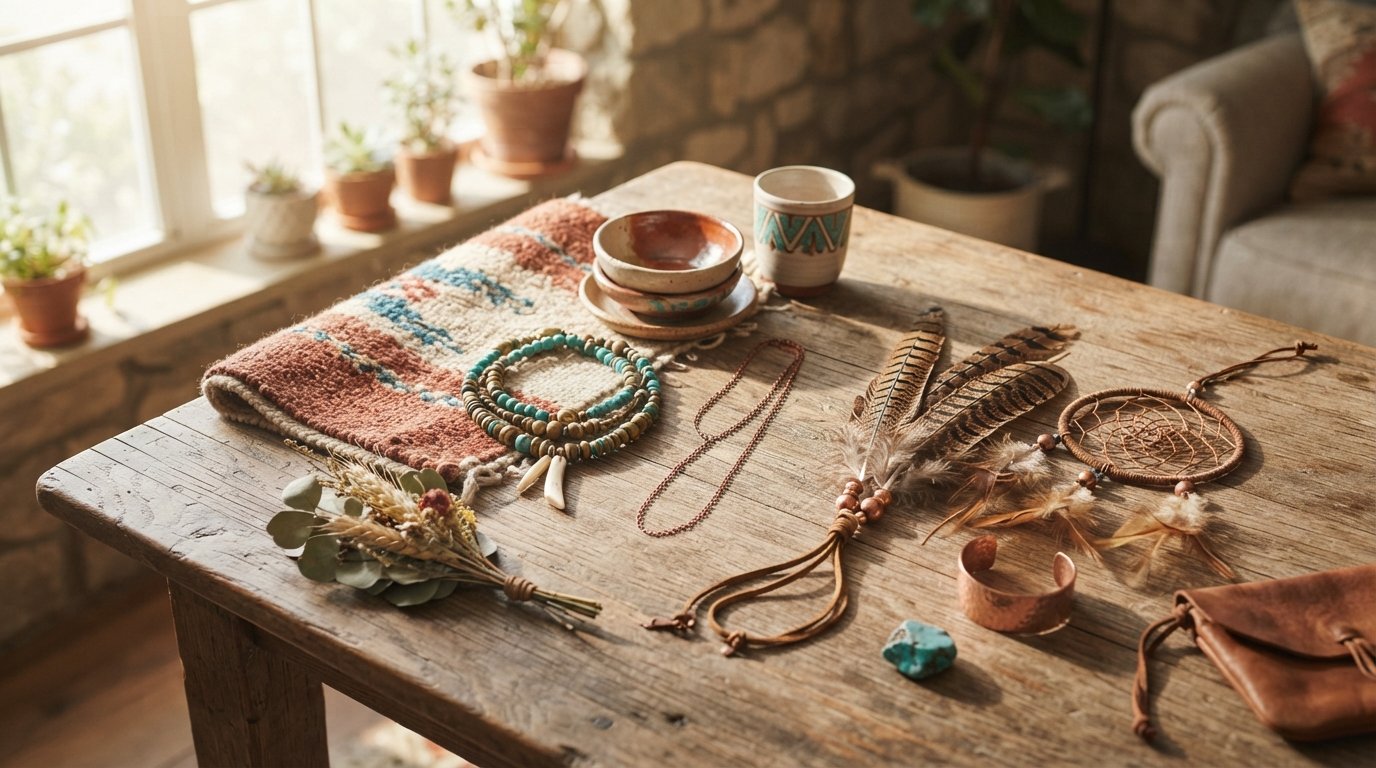
Native American accessories are far more than simple aesthetic ornaments; they reflect centuries-old stories, intricate craftsmanship and deep cultural meaning. Each piece, whether a hand-carved jewel or a leather bag, testifies to the richness and diversity of the Indigenous peoples of North America. Far from clichés and fleeting costumes, these objects are markers of identity, made with techniques passed down through the centuries. They complete an outfit or a Native American outfit with an authenticity that goes beyond fashion, rooted in a living heritage.
Native American Jewelry: The Symbolism of Materials and the Expertise of Artisans
The Native American bracelets, rings and earrings are emblematic of this craftsmanship. Sterling silver 925 is often the base material, worked by hammering, engraving or setting. Turquoise, the signature stone, is mined from specific deposits such as Sleeping Beauty or Kingman in Arizona. Each deposit produces unique shades and matrices, from pure blue to deep green with black or brown veining. A Navajo piece is recognizable by its solid silverwork and bold settings, while a Zuni piece excels in the meticulous inlay of many small cut stones.
Beyond silver and turquoise, other materials enrich these adornments. Coral, often red, symbolizes vitality. Onyx, jet, mother-of-pearl and spiny oyster shell are frequently used, worked into mosaics or fine inlays. These choices are not arbitrary; each stone, shell or mineral carries specific cultural and spiritual meaning, tied to the earth, the sky, protection or connection to the spirits. An expert will favor a piece with a natural patina, a sign of its age and authenticity, and will pay attention to the stone-cutting technique.
Native American Leather Goods: Everyday Functionality and Aesthetics
The Native American bags played an essential role in the life of Indigenous peoples, long before the advent of pottery. Made primarily from deer, bison or elk hide, they were used to carry tools, food, remedies or sacred objects. Apache fringed bags, for example, helped hide footprints in the sand, while the Navajo developed richly decorated pouches for precious items or remedies. Their sturdiness was essential for survival and travel, whether for nomadic Plains tribes or settled farming communities.
The design of an Indian bag reveals an ingenuity suited to its purpose. The seams, often made with animal sinew or braided leather, ensure exceptional durability against the elements. The ornaments, such as seed beads, porcupine quills or natural pigments, are not purely decorative. They can indicate tribal affiliation, the wearer’s status or key events in their life. A typical hunting bag from the Plains tribes could measure around 30×20 cm and was built to withstand decades of intensive use across varied terrain.
Native American Headdresses and Hair Ornaments: Between Ceremony and Identity
The Indian headdress is often, and wrongly, reduced to the image of the warrior “tribal chief.” Its role and meaning are in fact far more complex and varied depending on the people. For many Plains tribes, feathered headdresses (warbonnets) were symbols of great honor, awarded for exceptional acts of bravery or service to the community. Each eagle feather, for instance, had to be obtained legally and symbolized a specific merit, far from being a mere accessory. Wearing such headdresses was strictly regulated and not available to everyone.
Other peoples used less ostentatious hair ornaments that were nonetheless just as meaningful. The Hopi wove intricate headbands, while the Tlingit carved wooden combs adorned with totem animal motifs. The Cherokee, for their part, favored braids adorned with beads and ribbons. These adornments indicated age, marital status, clan affiliation or an individual’s spiritual role. Crafting time could span several weeks, illustrating the importance of these objects in Native American culture.
How can you tell an authentic Native American piece of jewelry from an imitation?
The authenticity of a Native American piece of jewelry can be verified through several specific points. Look for the artisan’s signature, often engraved on the back, and find out about the origin of the stones. Authentic pieces use sterling silver 925 and natural turquoise, recognizable by their distinctive matrices and colors. An unusually low price should raise a red flag. Favor pieces that mention Navajo or Zuni artisans. A specialist can offer you the best guarantees.
What are the most common types of turquoise used in Native American jewelry?
Several historic mines have supplied the turquoise used in Native American jewelry. Sleeping Beauty turquoise (Arizona) is prized for its uniform sky blue color with no matrix. Kingman turquoise, also from Arizona, offers a deeper blue, often with a black or copper matrix. Nevada Blue or Dry Creek turquoise displays lighter tones, sometimes a blue-white shade. Each variety has unique characteristics that influence the value and final look of the jewelry, allowing for highly personal choices.
How do I take care of my Native American silver and leather accessories?
For silver jewelry, use a soft cloth and a product specifically designed for silverware, avoiding rubbing inlaid stones with abrasive products. Leather requires regular hydration with a natural leather balm, especially if it is dry or exposed to sunlight. Store your accessories in a dry place away from direct light to prevent silver from tarnishing and leather from drying out, ensuring their long-term preservation.
Are Native American bags suitable for modern everyday use?
Yes, many Native American bags, whether satchels or pouches, are perfectly functional for everyday use. Their designs, often built with practicality in mind, offer enough space for essentials such as a phone, a wallet or keys. Choose a model made of thick leather with sturdy seams to ensure durability. Some artisans now incorporate modern closures or linings, blending traditional aesthetics with contemporary comfort for a distinctive accessory.
What is the meaning of feathers in traditional Indian headdresses?
The meaning of feathers in headdresses varies greatly depending on the tribe and context. Generally, eagle feathers, highly prized, symbolize bravery, strength and honors earned in battle or through acts of wisdom. Each feather was often awarded for a specific achievement, and wearing it was strictly regulated, reflecting high status and respect within the community. It is crucial to view these headdresses as sacred cultural artifacts and not merely decorative ornaments.